Life afterwards
Food
The province expects existing supply chains to stop working. Deliveries of fresh food could take weeks or months to recover. No level of government stores food for the public during that gap.
Last reviewed
At a glance
The province expects delivery networks for food and household supplies to take weeks or months to recover.
Expected disruption: Weeks or months
Source: Provincial Earthquake Immediate Response Strategy ↗ · Ministry of Emergency Management and Climate Readiness, Province of BC · v1.0 Aug 2022; v1.1 administrative updates Aug 2026
Food shops depend on electricity
A grocery shop is a building full of machines. Tills and card readers need power and a network. The cold case, the walk-in cooler and the freezer aisle need power to stay cold.
Chilled and frozen stock is on a clock from the moment the power goes, and a shop that cannot take payment cannot sell what is left. All of that happens indoors, before any delivery is late. What BC Hydro has published about how long the power stays off is on the electricity page.
Food comes in by truck, over the same roads as everything else, and a truck runs on fuel. The province’s planning assumptions: “Road, rail, air, and marine transportation will be disrupted, and existing supply chains will be inoperable.”
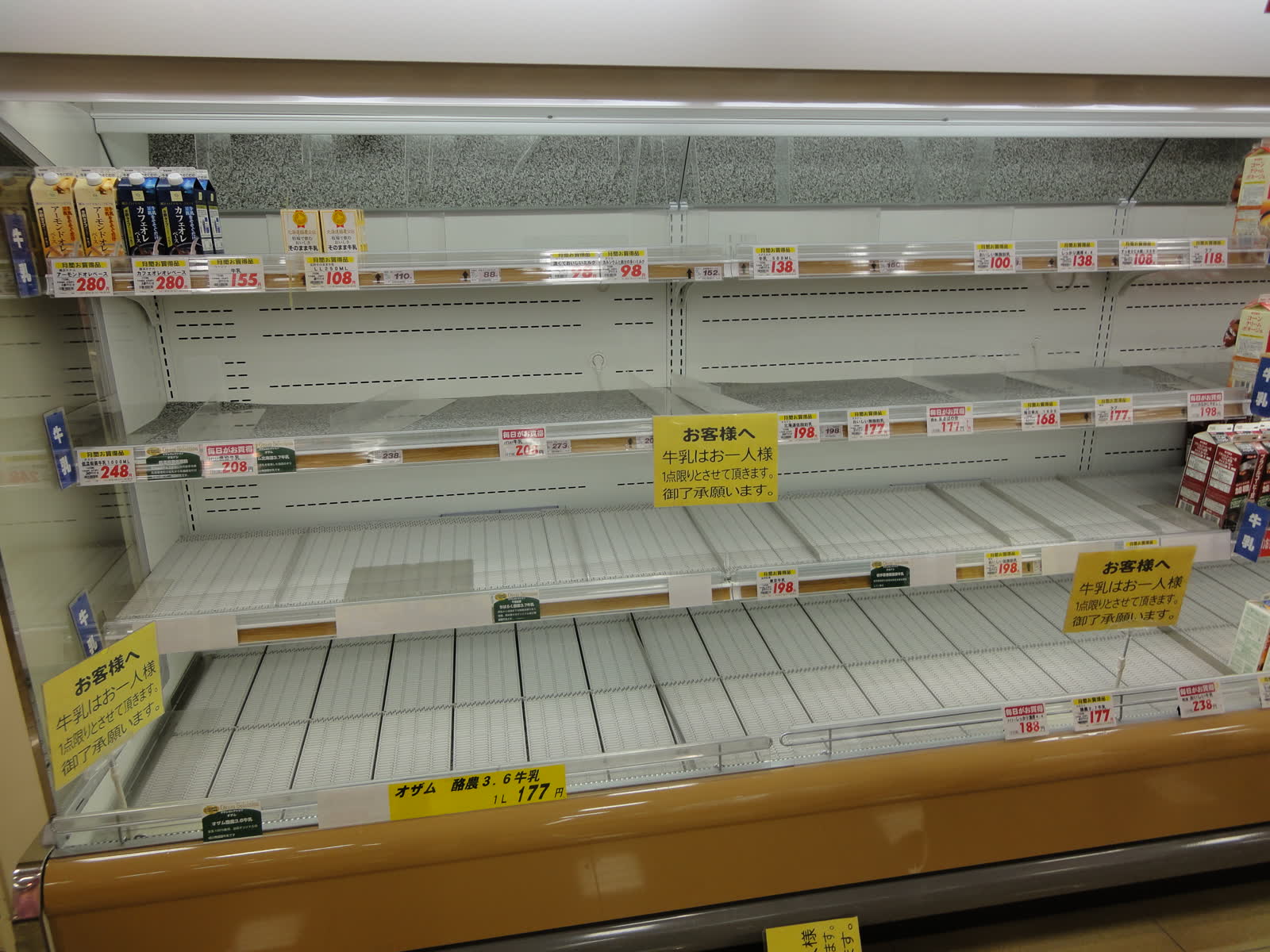
Fresh food deliveries could take months to recover
In its earthquake response strategy the province says the fast-moving consumer goods network “will be disrupted. It may take weeks or months to recover.” Fast-moving consumer goods is trade language; the same document glosses it as “products that are sold quickly and at relatively low cost, such as meat, fruits and vegetables, dairy products, baked goods, toiletries, and cleaning products”.
That list is a grocery shop. Four of the six things the province names are perishable: meat, produce, dairy, bread. Those are exactly the items no household can put by. A cupboard of tins answers a short gap; it does not answer weeks or months.
The other two the province names are toiletries and cleaning products. They travel in the same trucks, they keep indefinitely, and they are the two almost nobody stores.
The province’s own primary planning scenario is a shallow crustal magnitude 7.0 near Greater Vancouver, so the weeks or months is a statement about the nearer, smaller earthquake as well as the offshore one.
Governments do not stockpile food for the public
The National Emergency Strategic Stockpile holds medical equipment such as ventilators, cardiac monitors and personal protective equipment, pharmaceuticals, social service supplies such as beds and blankets, and mini-clinic triage units. Its own page mentions neither food nor water.
Agriculture and Agri-Food Canada, the department that would be asked for food, has no warehouses full of supplies, no direct access to or ownership of food or water supplies, limited water expertise, and would be challenged to lead a federal response to a request for safe food and water. That is its own March 2018 case study, obtained under freedom of information and reported by the Globe and Mail in 2019.
Emergency Support Services meets a household’s needs by purchasing from, or referring people to, local retailers after the event. There is no reserve behind it. That works for a house fire or a flood in one valley. Here it runs through the same retailers and the same roads the province expects to be disrupted, so it is at its weakest in exactly the event it is meant to cover.
Disaster support hubs do not store food
Vancouver designates 25 disaster support hubs, outdoor gathering places where group lodging and shelter may be provided depending on impacts. The City’s own neighbourhood toolkit describes what is there: basic items such as pens, whiteboards, signage and a tent, and beyond that “the skills, knowledge and supplies that people bring”. A hub is a coordination point and can be used to hand things out. There is no food in it waiting.
The Salvation Army’s BC disaster services director estimated it could produce up to 50,000 meals a day within two days of a major earthquake, rising with airdrops within a week, with road and bridge conditions dictating where those meals could go. The 2021 census counted 2,642,825 people in the Vancouver census metropolitan area. Neither source sets one figure against the other. A shelter kitchen at that scale is not a regional food supply.
The plan is that households stored the food themselves.
British Columbia has no public food emergency plan
The province’s index of its own emergency plans lists the All Hazard Plan, the earthquake response strategy, flood, drought, nuclear, pandemic, wildland-urban interface, tsunami notification, flood waste and debris, foreign animal disease, a post-secondary plan and a guide for schools. There is no food, grocery, consumer-goods or supply-chain plan among them. The ministry responsible for agriculture publishes emergency material about animal disease, wildfire, freshet and flooding at farm level, and mentions neither earthquakes nor food supply chains.
It is not the regional district’s either. Metro Vancouver scopes its emergency role, in its own words, to “the delivery of services including drinking water, wastewater treatment, solid waste management, housing, regional parks, and Electoral Area A”, plus 9-1-1 and public notification. Groceries are not among them.
What you can do
The province tells households to aim to be self-sufficient for up to two weeks. The same document says Emergency Support Services is designed to provide up to 72 hours of support and “is not designed for the scope and scale of services required after a catastrophic earthquake”.
- Build the pantry out of the part that keeps. Four of the six categories the province names are perishable, so the part of the shop a household can hold is the tinned, dried and bottled part. PreparedBC asks for non-perishable food for at least two weeks, with a manual can opener.
- Stock things that can be eaten without cooking. A stove, a kettle and a microwave all need power or gas arriving at the building.
- Store the things in a grocery shop that are not food. Soap, cleaning products and toilet paper fall into two of the six categories the province names, they travel in the same trucks, and they keep indefinitely.
- Count pets in the same calculation. The provincial guide asks for enough for each person and each pet in the home, for at least two weeks.
The province’s own reason for asking: prepared households “reduce pressure on overwhelmed government agencies and allow available resources to go where they are most needed”.
The full preparedness planSources on this page
Numbered in the order they are cited. Each entry links back to where it is used.
- [1]ReportProvincial Earthquake Immediate Response StrategyMinistry of Emergency Management and Climate Readiness, Province of BC · 2022Open the document ↗
- [2]ReportNational Emergency Strategic StockpilePublic Health Agency of Canada · 2026Open the document ↗
- [3]ReportVancouver's food and water supply vulnerable to massive earthquake, internal reports warnGlobe and Mail, over Agriculture and Agri-Food Canada · 2019Open the document ↗
- [4]ReportDisaster support hubsCity of Vancouver · 2017Open the document ↗
- [5]ReportResilient Neighbourhoods Toolkit, with Module 5 "Readying neighbourhood disaster response"City of Vancouver · 2019Open the document ↗
- [6]Report2021 Census Profile, Vancouver CMA (DGUID 2021S0503933)Statistics Canada · 2022Open the document ↗
- [7]ReportProvincial emergency planningEmergency Management and Climate Readiness, Province of BCOpen the document ↗
- [8]ReportEmergency management for agricultureBC Ministry of Agriculture and FoodOpen the document ↗
- [9]ReportEmergency management service pageMetro VancouverOpen the document ↗
- [10]ReportEarthquake and Tsunami Preparedness GuidePreparedBC / EMCR, Province of BC · 2024Open the document ↗