The shaking
Fire following
The shaking stops, and that is when the fires start. Many of them, in ordinary homes, in a city where the hydrants have just run dry. Every department is holding on to its own crews, and 911 has saturated.
Last reviewed
Most of the fires begin in houses and apartments
They start in the wiring behind the walls and the gas lines behind the appliances. About half of the ignitions in the Lower Mainland modelling are electrical and about a quarter gas-related. About 70 per cent of them may be in homes and apartments, a share the modelling takes from the 1994 Northridge earthquake in California, in the United States.
A hydrant is the end of a buried pipe
A fire engine does not carry much water. It carries enough to get started, and then it connects to a hydrant. The hydrant is the end of a buried pipe, and buried pipe is what an earthquake is good at breaking.
Across the study area the modelling runs to as many as 15,000 repairs to buried pipe, “the precise number and location depending on the scenario”, and “the general rule is about 20% of repairs are full breaks”. In three of the modelled earthquakes the fire loss is driven “primarily due to lack of water for firefighting”. Why the mains break, and how long they take to fix, is on the water page.
When a city runs short, it calls its neighbours
When a department runs out of engines it calls the next department along. In the first hours, that is expected to fail.
There are 98 fire halls in the study area and roughly 200 fire engines available for immediate firefighting. Every department will be holding on to its own crews, help from further away in the Lower Mainland is several hours of travel, and “The Fraser and other rivers are all barriers if bridges are impassable, which they will be at least initially due to the need to inspect for damage.”
Most engines in the study area, Burnaby’s among them, carry 4 inch large-diameter hose, while Vancouver Fire Rescue Services uses 5 inch hose, and they “lack adapters, which is an obstacle to effective mutual aid”. Two departments can arrive at the same fire and be unable to join their hoses.
Phone systems “will sustain some damage but not enough to reduce functionality”. The problem is how many people call at once. “Saturation, especially of the 911 system, will reduce functionality to a great degree, for several hours or more.”
So a fire in the first hours is a local matter. The engine that would come is at another fire, the department across the river is waiting on a bridge inspection, and the number people call is jammed. What happens to a small fire in that window depends on who is standing next to it.
The bigger earthquake is not the worse fire
A bigger earthquake does not mean a bigger fire. The modelled fire loss for the magnitude 9.0 Cascadia earthquake is $162 million. For a magnitude 7.3 crustal earthquake in the Georgia Strait, close to downtown, it is $10.7 billion, about 66 times as much.
The Cascadia rupture is far offshore, so the ground motion it delivers in Metro Vancouver is “relatively modest”. The Georgia Strait earthquake has “an epicentre very close to downtown Vancouver” and delivers “very strong” motion. The number of fires follows the shaking on the spot, not the magnitude in the headline.
“the largest number of fires in the Lower Mainland is not likely to be caused by a large CSZ event, but rather by closer shallower crustal events that occur during the build-up of crustal stresses prior to the main subduction zone event.”
CSZ there is the Cascadia Subduction Zone, the offshore fault. The federal work on building damage reaches the same ordering through its ground-motion model. See buildings.
| Earthquake | Fires started | Modelled fire loss |
|---|---|---|
| M9.0 Cascadia subduction | 16 | $162 million |
| M6.8 Juan de Fuca in-slab | 106 | $7.4 billion |
| M7.3 Leech River–Devil’s Mountain | 4 | $0.01 billion |
| M7.3 Georgia Strait crustal | 216 | $10.7 billion |
Median estimates in Canadian dollars, for fire damage only.
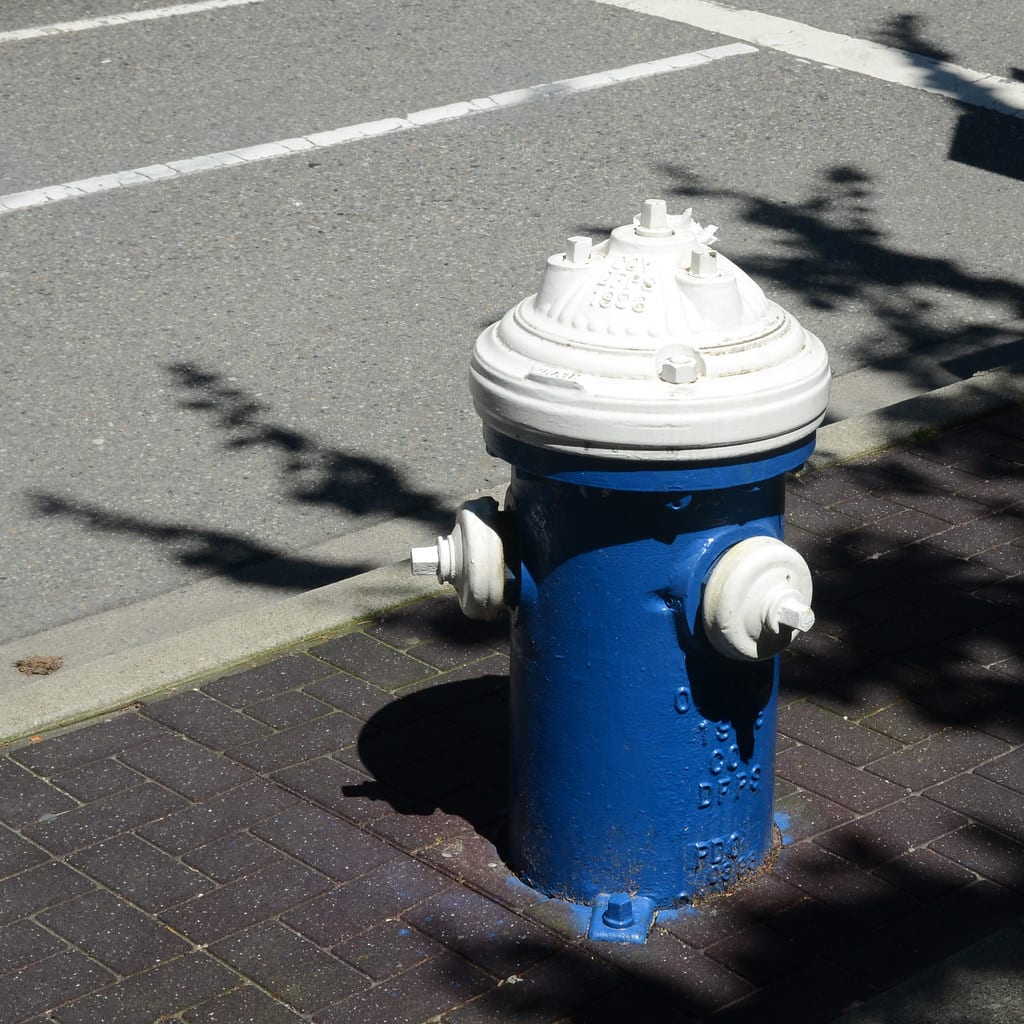
Downtown has a second water system, and its hydrants are blue
There is a second set of water pipes under part of Vancouver, built for nothing but fires, and it can draw straight out of the harbour. The Dedicated Fire Protection System is a $52 million network of two saltwater pumping stations and its own earthquake-resistant pipeline, serving the downtown peninsula, the West End, Fairview Slopes and Kitsilano. The first pump station opened at False Creek in September 1995, the second at Coal Harbour in February 1997, and the pipeline was finished in 2003. The Fairview Slopes extension was justified partly “to protect Vancouver Hospital, the primary emergency care facility for the province”. The City publishes the mains themselves as an open data layer, street by street.
The dedicated fire protection mains sit in a corner of the city about 4 km by 3 km, in a city about 15 km across: the downtown peninsula, the West End, and a crossing of False Creek into Fairview Slopes and Kitsilano. What is drawn is the pipe and not a service area, and everywhere the pipe is not, a fire is fought with water from the ordinary mains.
The dedicated fire protection network
About 4 km by 3 km of a city 15 km across
241 runs of main, and no others anywhere in the region
The system has not grown since. The last hydrants went into Kitsilano in 2003, and the City describes 2003 as the end of the build. Everywhere else in Vancouver, and everywhere in every other municipality, firefighting depends on the ordinary water mains. The pumps have never had to draw seawater for a fire.
The City’s Hazard and Risk Explorer describes the system at length: built to withstand the largest earthquake considered credible for the region, able to draw fresh or salt water, hardened mains, “hydrants (the big, blue ones)”, two high-capacity pump stations, and built on the lesson of the 1906 fire in San Francisco, in the United States. It names no coverage area.
The coverage sentence exists on a different page, filed under infrastructure. No map, address lookup or neighbourhood check on vancouver.ca tells a resident which side of the line they are on. The blue hydrants are the only part of the description a reader can act on, and they arrive without the geography beside them.
A sprinkler head is fed from the street
New construction in Vancouver has to be sprinklered. A sprinkler is a pipe with water in it, and the water comes up from the main under the road. “However, sprinklers rely on underground water mains for supply, which are likely to fail in a major earthquake.”
California has required an answer to that for decades: in its high-earthquake zones, a high-rise has to hold its own secondary water supply on site, typically about 60,000 litres. “Vancouver and the Provincial Building By-laws lack a similar provision.” The Vancouver Building By-law in force today still carries no such requirement. The study puts the cost at “significantly less than 1% of the value of the building — perhaps on the order of the cost to renovate the building lobby”, taking up “the equivalent of perhaps two parking spaces”.
Vancouver already builds them, for other reasons. Oakridge Centre’s fire engineering records carry a secondary water supply designed “to provide a 2-hour design duration”, sized for the City’s assumption of three fires at once and not for an earthquake ; a building comment on 1489 West Broadway raises “possibly the provision of secondary water supply (i.e. water tank)” ; and the drawings for 600 Robson Street label a “SECONDARY WATER SUPPLY ROOM” on the second parking level. None of it has ever been required, and none of it has been tied to an earthquake.
The engines have to get out of the hall first
The hall is a building too. Vancouver has 19 fire halls and five specialty fire facilities, worth about $642 million to replace, about 58 per cent of them in good or fair condition, and 30 years old on average. The City’s own capital plan states the problem: “There is also a need to increase the resilience of these facilities to ensure that most, if not all, will remain operational after a major event such as an earthquake.”
Fire Hall #12 in Kitsilano was chosen for seismic upgrade because it sits in “a relatively large geographic area (west of Arbutus Street) where no fire hall meets current seismic standards”, and the same document records that the Metro Core “has five fire halls, all of which were built in the 1970s or earlier”.
Individual halls are moving. Hall #17 on Knight Street opened in September 2023 as a post-disaster communications hub; halls #8 in Downtown South and #9 in Grandview are being rebuilt to post-disaster standard for 2029; hall #2 on Main Street, built in 1974, no longer meets current seismic standards and is being replaced; hall #1 is to be seismically upgraded. Against that, the whole climate and seismic resilience category of the 2027 to 2030 capital plan is $24 million of a $3.5 billion plan, and the seismic part of it is $1 million for risk assessments on five City buildings.
Vancouver’s 19 fire halls are spread across the whole city. One is finished to a post-disaster standard and 5 more are named in a capital plan for replacement or seismic upgrade. The other 13 are marked as needing more information, because the documents this site has read say nothing either way about them. That is a gap in the evidence and not a finding about the buildings.
Vancouver's fire halls
13 of 19 need more information
One is finished to a post-disaster standard. Five more are named in a plan
Elsewhere the picture is thin and uneven. Burnaby builds new halls to post-disaster standard, and says so for Fire Station 8 on Burnaby Mountain and Fire Station 4 at Greystone, which opened in July 2024. The District of North Vancouver says the Norgate hall replacement “will be built to post-disaster standards”. In Richmond, the fire chief told a council committee in March 2026 that “all Richmond firehalls are rated to withstand major disasters”, with the oldest under renovation and the second oldest brought up to standard some years earlier. That is an officer’s answer recorded in minutes. No hall-by-hall engineering rating was published, and the phrase is not the one the building codes use.
What you can do
- Find out which side of the line you are on. The dedicated fire system covers the downtown peninsula, the West End, Fairview Slopes and Kitsilano, and nothing else. The City’s own identifier for it is the hydrant colour: the big blue ones are on the dedicated system. Everywhere else, including most of Vancouver, the water for fighting a fire comes through the ordinary mains.
- If you live or work in a tall building, ask what water the sprinklers have. Sprinklers draw on the underground mains, and the mains are what breaks. California requires a high-rise in its earthquake zones to keep its own supply on site; Vancouver and the provincial by-laws do not. The published price for it is well under 1 per cent of a building’s value and about two parking spaces of floor area, which makes it a fair question to put to a strata council or a building owner.
- Plan on the first hours being yours. The 911 system is expected to saturate for several hours or more, and help between fire departments is expected to be largely ineffective over the same period. A small fire stopped in its first minutes is one nobody has to cross a broken city to reach.
Sources on this page
Numbered in the order they are cited. Each entry links back to where it is used.
- [1]ReportScawthorn, C., Fire following earthquake in the Vancouver region, ICLR Research Paper Series 67, 74 pp.; ISBN 978-1-927929-29-2Institute for Catastrophic Loss Reduction / SPA Risk LLC · 2020Open the document ↗
- [2]ReportHow Vancouver prepares for emergenciesCity of VancouverOpen the document ↗
- [3]ReportCouncil report, "Direct Purchase of Dedicated Fire Protection System Fire Hydrants"City of Vancouver · 2001Open the document ↗
- [4]DatasetDedicated Fire Protection System water mains, Open Data PortalCity of VancouverOpen the document ↗
- [5]ReportWhy big blue fire hydrants…Vancouver Is Awesome · 2022Open the document ↗
- [6]ReportHazard & Risk Explorer, Earthquake and Introduction chaptersCity of Vancouver (ArcGIS StoryMaps) · 2025Open the document ↗
- [7]ReportVancouver Building By-law 2025, Book I Volume 1City of Vancouver · 2026Open the document ↗
- [8]ReportOakridge Centre fire-engineering meeting minutes, 13 Feb 2019, item 2.2 Secondary Water SupplyCity of Vancouver · 2019Open the document ↗
- [9]ReportProcessing Centre building comment, 1489 West BroadwayCity of VancouverOpen the document ↗
- [10]ReportDevelopment drawings, 600 Robson StreetCity of VancouverOpen the document ↗
- [11]Report2027–2030 Capital Plan (19 fire halls; FH#1/#8/#9 post-disaster)City of Vancouver · 2026Open the document ↗
- [12]Report2019–2022 Capital PlanCity of Vancouver · 2018Open the document ↗
- [13]Report2023–2026 Capital PlanCity of Vancouver · 2022Open the document ↗
- [14]DatasetFire halls, Open Data PortalCity of Vancouver · 2026Open the document ↗
- [15]ReportFire Station 8 project pageCity of Burnaby · 2026Open the document ↗
- [16]ReportFirehall No. 5 (Norgate) replacement projectDistrict of North VancouverOpen the document ↗
- [17]ReportCommunity Safety Committee minutes, 10 Mar 2026, item 3City of Richmond · 2026Open the document ↗
- [18]Report2026–2030 Capital PlanCity of North Vancouver · 2026Open the document ↗