Life afterwards
Fuel
Fuel powers generators, repair crews and the distribution of other critical supplies. The province assumes existing supply chains will be inoperable after the earthquake.
Last reviewed
At a glance
Fuel is the resource every other distribution depends on, and the province expects supply chains to be inoperable.
Expected disruption: Weeks to months, while supply routes run at reduced capacity
Source: Provincial Earthquake Immediate Response Strategy ↗ · Ministry of Emergency Management and Climate Readiness, Province of BC · v1.0 Aug 2022; v1.1 administrative updates Aug 2026
Fuel keeps every other supply moving
The Provincial Earthquake Immediate Response Strategy is British Columbia’s operational plan for the days after a major earthquake. Of the resources it calls critical, it sets one apart:
“Fuel also holds a unique position as a critical resource due to its requirement in the distribution of all other supplies, first responder activities, and enabling functionality of certain impacted facilities and infrastructure that rely on generators.”
Fuel moves every other supply, carries the people who respond, and runs the generators under the buildings that have lost their power.
The same plan assumes the movement stops: “Road, rail, air, and marine transportation will be disrupted, and existing supply chains will be inoperable.” That is written against the province’s primary planning scenario, a shallow magnitude 7.0 earthquake near Greater Vancouver.
Fuel pumps need electricity
A pump is an electric motor. The till beside it is a computer and the card reader needs a network. A station with full underground tanks hands out nothing while the power is off, and neither does an undamaged station the delivery truck cannot reach.
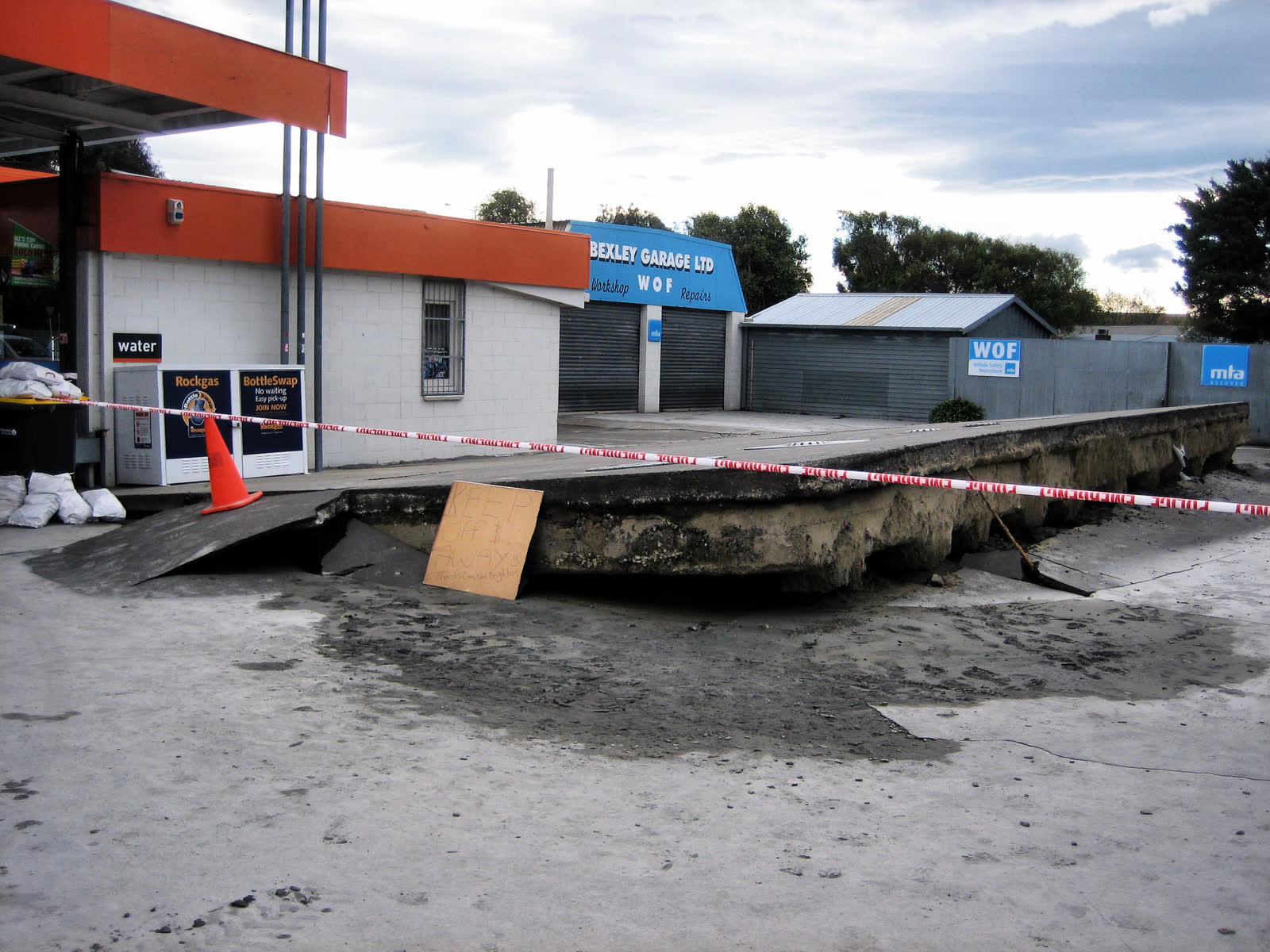
In the first week, fuel arrives or does not arrive on two things: the power line that runs the station’s pumps, and the road the tanker comes down. What BC Hydro has published about how long power takes to come back is on the electricity page, and what the province expects of the roads is on the transportation page.
British Columbia restricted fuel purchases by emergency order in 2021
In November 2021 the province issued an emergency order restricting fuel purchases across the southwest of British Columbia.
That was a flood, and a smaller disruption than a major earthquake would bring. It is still what a fuel shortage has looked like here: a provincial order setting a limit on what a person may buy.
Hospital generators need regular fuel deliveries
A hospital is the clearest case of a building running on a generator. A generator holds hours or days of diesel, not weeks. When it runs low, somebody has to drive more of it there, over the same roads as everything else.
The new Surrey hospital and the new St. Paul’s, both still being built, each specify 72 hours of self-sufficiency for fuel, water and sanitary holding, in identical terms.
That figure lives in two project agreements. It is not a code, not a standard, and it reaches no hospital already open. What Vancouver General, Surrey Memorial, Burnaby, Lions Gate, Richmond or St. Paul’s on Burrard hold in their tanks is not in the public record.
Repair crews compete for the same fuel
The crews restoring electricity drive to the poles. The trucks carrying food run the same roads as everything else. Bulk fuel arrives at terminals and wharves on the same shoreline and the same delta soils as the ports. Every one of those movements needs the roads and bridges to be passable.
A service station needs the grid to run its pumps. The grid needs fuel to run the generators and to move the crews who bring it back.
The province plans on the routes being “damaged or only partially functional and operating at a much-reduced capacity for an extended period (weeks to months)”, and on the rail network being “largely unusable during the immediate response phase”. Road and rail are the two ways fuel moves in quantity.
What you can do
A household cannot stock its way through a fuel shortage. What helps is decided before the earthquake.
- Keep the tank above half. The fuel already in the car is the fuel you can count on when the pumps have no power, and half a tank costs nothing to carry.
- Work out now what you could reach without a car. Find out which of the places you would need to get to are within walking or cycling distance, and keep a bicycle in working order if you have one. What the province plans for people while the crossings are shut is in getting around.
- Do not store fuel at home. It is a fire risk, and a can in the garage is no answer to roads the province plans on running at much-reduced capacity for weeks to months.
None of this makes the fuel come back sooner. It decides how much of your week depends on it.
The full preparedness planSources on this page
Numbered in the order they are cited. Each entry links back to where it is used.
- [1]ReportProvincial Earthquake Immediate Response StrategyMinistry of Emergency Management and Climate Readiness, Province of BC · 2022Open the document ↗
- [2]ReportB.C. floods: Getting past fuel shortage could take weeks, analyst saysGlobal News · 2021Open the document ↗
- [3]ReportBrown, A., The Fuel Transportation System in Coastal British Columbia: Attributes and VulnerabilitiesUBC Open Collections · 2016Open the document ↗
- [4]ReportEmergency order restricting fuel purchases, November 2021 floodsProvince of BC · 2021Open the document ↗
- [5]ReportNew Surrey Hospital and BC Cancer Centre, Design-Build Agreement Schedule 1Fraser Health / Infrastructure BC · 2023Open the document ↗
- [6]ReportThe New St. Paul's Phase 1a, Final Project Agreement Schedule 3Providence Health Care · 2025Open the document ↗
- [7]Analogue event東日本大震災における石油供給について (Petroleum supply in the Great East Japan Earthquake), briefing to the Cabinet Office disaster-management councilMETI / Agency for Natural Resources and Energy · 2011Open the document ↗